27 OCT 2022
Human inflammatory bowel disease (IBD) is a chronic inflammatory condition comprising two major disorders, Crohn’s disease (CD) and ulcerative colitis (UC). The fundamental symptoms of IBD are diarrhea, abdominal pain, rectal bleeding, and weight loss1. Both diseases affect men and women equally and may occur in adolescents as well as in adults2.
Among the two diseases, UC is more prevalent than CD. It is estimated that 2.6 and 1.2 million patients were affected by UC in Europe and North America, respectively3. The condition typically begins in the rectum and progresses continuously and proximally along the entire colon. The clinical course is unpredictable, characterized by alternating periods of relapsing and remitting mucosal inflammation4. Despite advances in treatment in recent years, colectomy is still required in up to 15% of patients, and only around 40 % of patients achieve clinical remission at the end of a year5, urging the development of new therapeutic strategies. Therefore, in order to establish new therapeutic approaches, a stable and reliable animal model is required for pre-clinical pharmacology and efficacy studies to increase the process of drug development.
The dextran sulfate sodium (DSS)-induced colitis is a chemically-induced model using DSS in the drinking water that induces ulcerative colitis-like inflammation. It is believed that DSS does not directly induce intestinal inflammation, but rather causes chemical injury to the intestinal epithelium. The damaged intestinal lamina propria are thus exposed to luminal antigens and enteric bacteria to trigger an immune response and inflammation. DSS-induced murine colitis model is commonly used to study the mechanisms of gastrointestinal inflammation as it resembles the epithelial damage observed in humans morphologically and symptomatically6. Depending on the duration and frequency of DSS administration, acute or chronic colitis could be induced in the animals. Acute DSS-induced colitis is associated with impaired epithelial barrier function and innate immunity, while adaptive immunity Th1/Th2 especially Th2, is involved in chronic DSS-induced colitis7.
PDS offers efficacy testing using C57BL/6 or BALB/c mice in the DSS-induced colitis model. In acute DSS model, C57BL/6 or BALB/c mice will be given DSS at 2.5% or 5%, respectively, in autoclaved drinking water for 5 days (Day 1 to Day 5), then normal drinking water for the following 7 days (Day 6 to Day 12). Test articles and the standard reference agent, Minocycline at 100 mg/kg or Cyclosporin A, 25 mg/kg, will be orally (PO) administered daily from Day 6. The body weight, fecal occult blood, and stool consistency will be recorded daily starting from Day 6 and the disease activity index (DAI) will be calculated every other day throughout the study (see Figure 1). Animals are euthanized on Day 12, and the colon length and the colon-to-body weight ratio will be measured and calculated for each animal.
For chronic DSS model, C57BL/6 mice will be given DSS at 2.5% in autoclaved drinking water for 5 days, followed by normal drinking water for 7 days, and this cycle repeats three times until Day 30. Test articles and the standard reference agent, Minocycline at 100 mg/kg, will be orally (PO) administered daily on DSS treatment days for a total of 15 doses. The body weight, fecal occult blood, and stool consistency will be recorded, and the disease activity index (DAI) will be calculated every other day throughout the study (see Figure 2). Animals are euthanized on Day 30, and the colon length and the colon-to-body weight ratio will be measured and calculated for each animal. For both models, additional services, including histopathology and biomarker analysis, can be provided upon request.
Our laboratory staff has an average of 15 years of experience in conducting in vivo pharmacology studies. We fully comply with the species-specific recommendations of The Guide for the Care and Use of Laboratory Animals (2011) for husbandry and animal handling and conduct studies within the facility accredited by the Association for Assessment and Accreditation of Laboratory Animal Care International (AAALAC International).
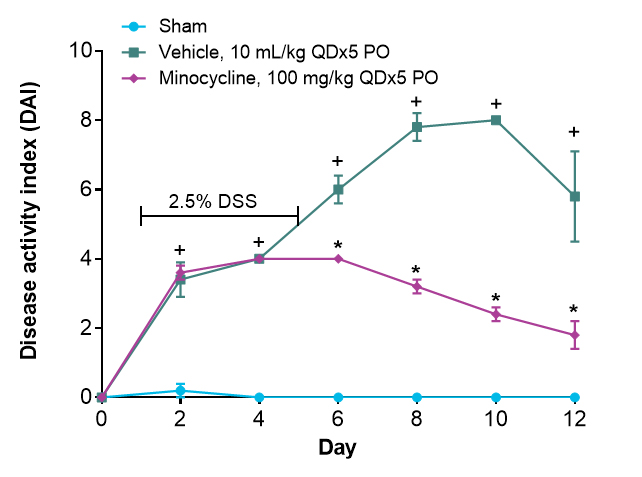
+p<0.05, vehicle vs. sham control; *p<0.05, treated vs. vehicle control; two-way ANOVA followed by Bonferroni test
Figure 1. Acute DSS model
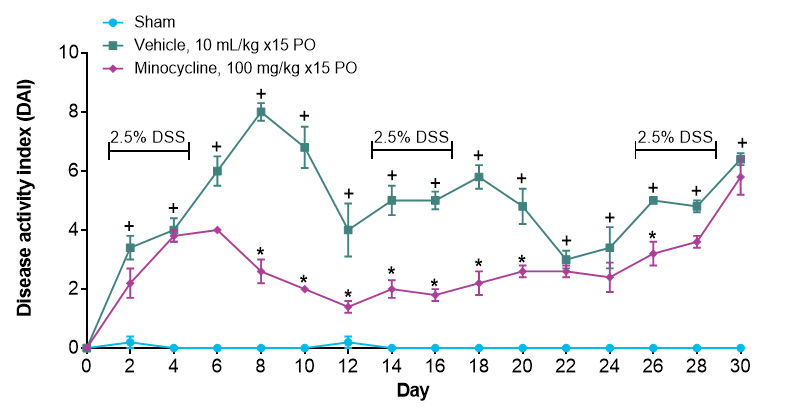
+p<0.05, vehicle vs. sham control; *p<0.05, treated vs. vehicle control; two-way ANOVA followed by Bonferroni test
Figure 2. Chronic DSS model
| Digestive System In Vivo Models | ||
|---|---|---|
| Model Name | Item Number | TAT |
| Inflammatory Bowel Disease (IBD), Chronic, DSS-Induced Colitis, Mouse | 553440 | 60 days |
| Inflammatory Bowel Disease (IBD), DSS-Induced Colitis, Mouse | 553420 | 30 days |
| Inflammatory Bowel Disease (IBD), DSS-Induced Colitis, Rat | 553425 | 20 days |
- Zhang YZ, Li YY. Inflammatory bowel disease: pathogenesis. World J Gastroenterol. 2014 Jan 7;20(1):91-9
- Zhang YZ, Li YY. Inflammatory bowel disease: pathogenesis. World J Gastroenterol. 2014 Jan 7;20(1):91-9.
- Seyedian SS, Nokhostin F, Malamir MD. A review of the diagnosis, prevention, and treatment methods of inflammatory bowel disease. J Med Life. 2019 Apr-Jun;12(2):113-122.
- Ungaro R, Mehandru S, Allen PB, Peyrin-Biroulet L, Colombel JF. Ulcerative colitis. Lancet. 2017 Apr 29;389(10080):1756-1770.
- Hirten RP, Sands BE. New Therapeutics for Ulcerative Colitis. Annu Rev Med. 2021 Jan 27;72:199-213.
- Eichele DD, Kharbanda KK. Dextran sodium sulfate colitis murine model: An indispensable tool for advancing our understanding of inflammatory bowel diseases pathogenesis. World J Gastroenterol. 2017 Sep 7;23(33):6016-6029.
- Perše M, Cerar A. Dextran sodium sulphate colitis mouse model: traps and tricks. J Biomed Biotechnol. 2012;2012:718617.