
Inflammatory Bowel Disease (IBD), DSS-Induced Colitis, Chronic
CONTACT CUSTOMER SERVICE
ADD TO FAVORITES
ADD TO PANEL
OVERVIEW
DOCUMENTS/REFERENCES
BIOLOGICAL INFORMATION
BACKGROUND INFORMATION
Human inflammatory bowel disease (IBD) is a chronic inflammatory condition comprising two major disorders, Crohn’s disease and ulcerative colitis. The dextran sulfate sodium (DSS)-induced colitis is a chemically-induced model using DSS in the drinking water that induces ulcerative colitis-like inflammation. The fundamental symptoms of IBD are abdominal pain, bloody diarrhea, and body weight loss. The DSS-induced colitis model is commonly used to study the mechanisms of gastrointestinal inflammation and evaluate the therapeutic efficacy.
ORGANISM
Mouse
ASSAY INFORMATION
ASSAY TYPE
In Vivo
TESTING INFORMATION
PROCEDURE SUMMARY
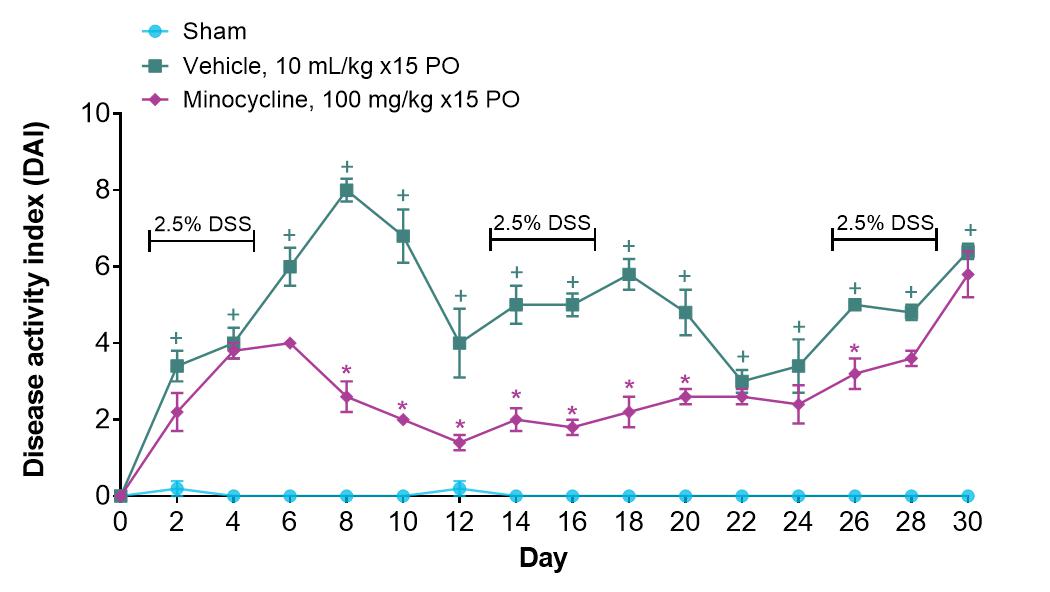
Groups of 6 female C57BL/6 mice at the age of 8-9 weeks old are used. Dextran sulfate sodium (DSS), molecular weight 36,000-50,000 Da (MP Biomedicals) are used. 2.5% DSS is given in autoclaved drinking water for 5 days in each cycle followed by a recovery period of 7 days with normal drinking water. Animals are exposed to three cycles in total. The mice in Sham group are given drinking water only. Test articles, vehicle (10 mL/kg, PO), and the standard, Minocycline (100 mg/kg, PO) are administered during the DSS challenge periods for a total 15 treatments. During the study period, body weight, fecal occult blood, and stool consistency will be recorded every other day. On Day 30, the mice are euthanized by CO₂ asphyxiation and the colon is weighed and its length recorded. Colon-to-body weight ratio is calculated for each animal according to the formula: colon weight (g)/BW×100%. The “Net increase” in the ratio of vehicle-control+DSS group relative to vehicle-control group is used as a base for comparison with treated groups and expressed as “Dec. (%)” (Decrease percentage). Additional analyses that can be requested include MPO, biomarkers (protein and/or mRNA), flow cytometry and histopathology, etc. ANOVA and Dunnett’s test are used to ascertain the difference between vehicle control and treated mice. Significance is set at p<0.05 level.
CRITERIA FOR SIGNIFICANCE
p<0.05 compared to vehicle control is considered significant activity
TURNAROUND TIME
STANDARD
60 Days
CLINICAL RELEVANCE
THERAPEUTIC AREA
Inflammation/Allergy
ADDITIONAL INFORMATION
BRAND
PDS
TESTING LOCATION
Taiwan - Taipei
OTHER INFORMATION
We will readily accommodate client-specified alterations. These studies are performed at our AAALAC accredited BSL-2 laboratory in Taipei, Taiwan. All aspects of this work are performed in general accordance with the Guide for the Care and Use of laboratory animals (National Academy Press, Washington, DC, 2011). The study protocol was approved by the Pharmacology Discovery Services IACUC and is performed with the oversight of veterinarians to assure the humane treatment of laboratory animals.
ITEM DOES NOT EXIST
© Copyright 2026, Pharmacology Discovery Services – Privacy Policy | Cookie Notice | Cookie Preferences