05 Jan 2023
Diabetes mellitus is an augmenting problem with huge social, health, and economic consequences globally. According to International Diabetes Federation (IDF), the global diabetes prevalence in 2021 is estimated to be 10% (537 million people), rising to 11% (643 million) by 2030 and 12.5% (783 million) by 2045. It is estimated that diabetes was responsible for 6.7 million deaths in 20211. Diabetes-related complications—including cardiovascular disease, kidney disease, neuropathy, blindness, and lower-extremity amputation—significantly increase patient morbidity and mortality while placing a large financial burden on the healthcare system2.
In addition to the complications mentioned above, diabetic patients are at increased risk of urinary tract infections (UTIs), bladder issues, and sexual dysfunction. In these patients, UTIs are more severe, caused by more resistant pathogens, and are associated with worse outcomes in diabetics, possibly owing to interfered blood flow, nerves, and sensory function associated with diabetes3. One of the most common pathogens in diabetes-related UTIs is Escherichia coli, which is responsible for 70% of these infections4. However, due to the increased emergence of antibiotic-resistant strains, treatment options for these UTI pathogens are growing limited. Therefore, in order to establish new therapeutic approaches for these patients, a stable and reliable animal model is required for pre-clinical pharmacology and efficacy studies to aid in the process of drug development.
Streptozocin (STZ) induced diabetes in mice is widely used as a rodent model of diabetes, as this model has the advantage of low cost and resultant pathology resembling diabetes in humans. In the STZ diabetes model, diabetic mice are generated by multiple administrations of low-dose STZ5. UTI introduced in STZ-induced diabetic mice is achieved by transurethral infection of the tested pathogens, and this model has been shown to be consistent with epidemiologic observations of diabetic UTI6, making it ideal for the efficacy testing of antibiotics.
PDS offers efficacy testing using SPF C3H-HeN mice in the streptozocin (STZ) induced type 1 diabetes mouse urinary tract infection (UTI) model. The animals will be induced with type 1 diabetes by intraperitoneal injection of 150 mg/kg STZ 13 and 10 days before infection, with overnight fasting before each injection. The animals will be transurethrally infected with E. coli strain ATCC 700336 under anesthesia by pentobarbital, followed by dose administration (IV, PO, SC, or PO) starting at any time point between 2 and 36 h post-infection. Animals are euthanized at 26 or 48 h after inoculation, and the bacterial enumeration in bladder and kidney tissues was conducted. Additional services, including cytokine measurement, histopathology, and PK analysis, can be provided upon request. Our laboratory staff has an average of 15 years of experience in conducting in vivo pharmacology studies. Relative husbandry and animal handling comply with the species-specific recommendations of The Guide for the Care and Use of Laboratory Animals (2011) and are conducted within the facility accredited by the Association for Assessment and Accreditation of Laboratory Animal Care International (AAALAC International).
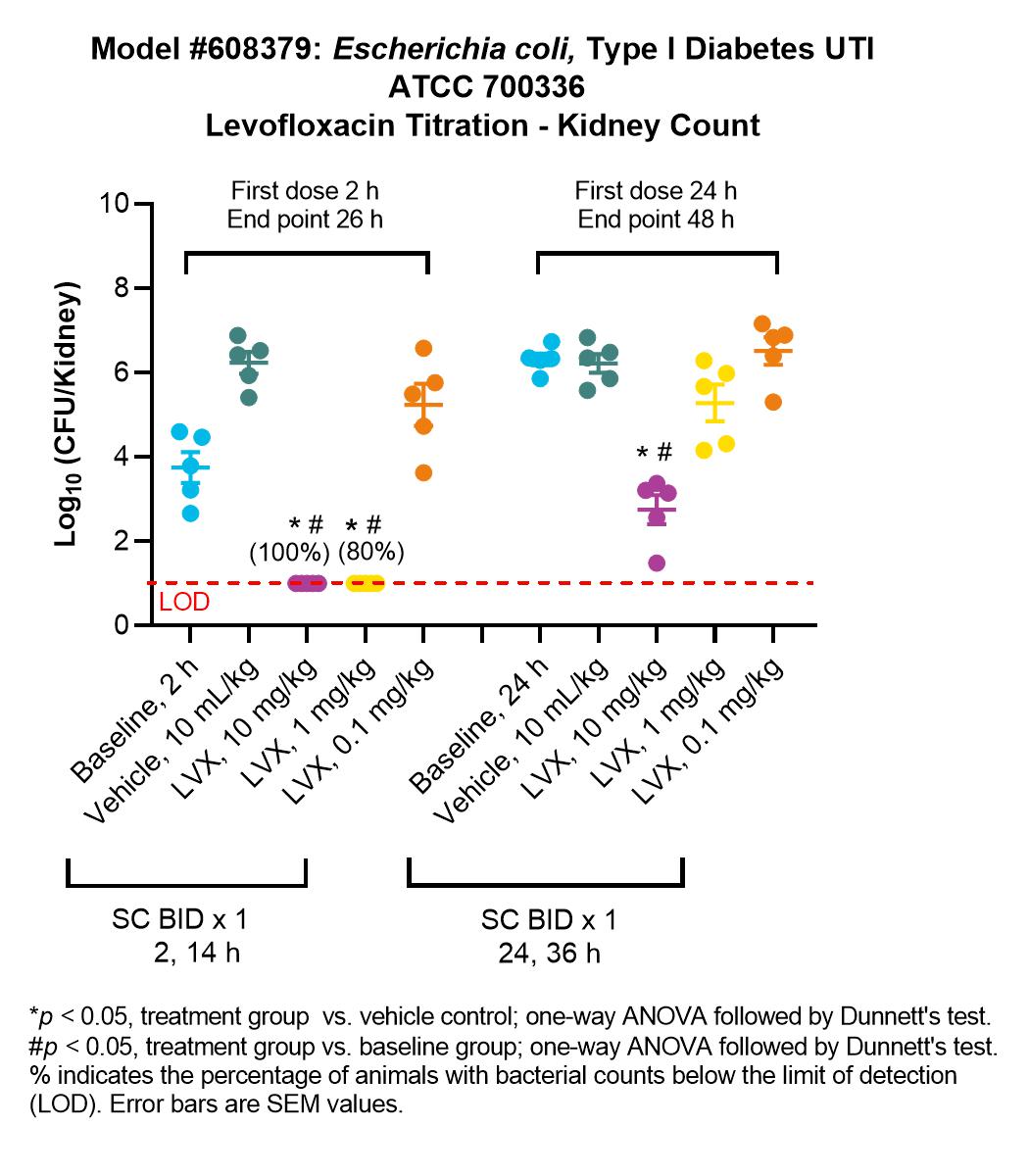
Figure 1. Levofloxacin efficacy in the Escherichia coli ATCC 700336 STZ-induced diabetic urinary tract infection (UTI) model, bacterial enumeration of kidney (CFU/Kidney), scatter plot. Female specific-pathogen-free C3H-HeN mice were used. Type I diabetes was induced by intraperitoneal injection of 150 mg/kg streptozocin (STZ) at 13 and 10 days prior to infection. Animals were fasted overnight before STZ injection. On Day 0, animals were transurethrally injected with E. coli ATCC 700336 suspension under pentobarbital anesthesia. Vehicle and levofloxacin were then subcutaneous (SC) administered twice (BID) at 2 and 14 hours later or 24 and 36 hours later. Animals were sacrificed at 26 or 48 h post-infection, and the kidney tissues were harvested from each of the test animals. The bacterial counts of kidney tissue (CFU/Kidney) were measured.
| In Vivo Models | ||
|---|---|---|
| Model Name | Item Number | TAT |
| Escherichia coli (ATCC 700336), STZ-induced diabetic UTI model, CFU/tissue, Mouse | 608379 | 40 days |
- International Diabetes Federation. IDF Diabetes Atlas, 10th edn. Brussels, Belgium: International Diabetes Federation, 2021.
- Deshpande AD, Harris-Hayes M, Schootman M. Epidemiology of diabetes and diabetes-related complications. Phys Ther. 2008 Nov;88(11):1254-64.
- Nitzan O, Elias M, Chazan B, Saliba W. Urinary tract infections in patients with type 2 diabetes mellitus: review of prevalence, diagnosis, and management. Diabetes Metab Syndr Obes. 2015 Feb 26;8:129-36.
- Dalal S, Nicolle L, Marrs CF, Zhang L, Harding G, Foxman B. Long-term Escherichia coli asymptomatic bacteriuria among women with diabetes mellitus. Clin Infect Dis. 2009 Aug 15;49(4):491-7.
- Furman BL. Streptozotocin-Induced Diabetic Models in Mice and Rats. Curr Protoc Pharmacol. 2015 Sep 1;70:5.47.1-5.47.20.
- Rosen DA, Hung CS, Kline KA, Hultgren SJ. Streptozocin-induced diabetic mouse model of urinary tract infection. Infect Immun. 2008 Sep;76(9):4290-8.