03 JUN 2022
CDAHFD Diet-Induced NASH Model in Humanized Liver Chimeric Mice
Nonalcoholic steatohepatitis (NASH) is an increasingly prevalent and serious liver disease affecting millions of people globally. With over 115 million cases reported worldwide currently, that number is projected to escalate to 357 million by 20301. This rise will lead to a significant impact on healthcare costs and patient outcomes. Notably, NASH already has an estimated healthcare cost of over $100 billion per year in the United States alone2. And as the disease becomes more common, the cost is expected to increase even further.
This debilitating disease is characterized by the accumulation of fat in the liver, inflammation, and liver cell damage, and is closely associated with obesity, diabetes, and metabolic syndrome. Unfortunately, NASH can progress to cirrhosis and liver failure, with no FDA-approved medication currently available to treat this condition. To add to this problem is often asymptomatic in its early stages, with many patients not being diagnosed until they develop advanced liver disease, which can significantly impact their quality of life 3.
Given the severity of this disease, there is an urgent need for effective treatments to prevent disease progression and improve patient outcomes. PDS has successfully developed methods to aid researchers tackling this potentially fatal disease.
One promising approach is the use of humanized mouse models, specifically the choline-deficient, amino acid-defined high-fat diet (CDAHFD)-induced NASH model. This cutting-edge model is created by transplanting human liver cells into mice fed a diet that mimics the lifestyle factors contributing to NASH in humans4. The resulting model accurately replicates the key features of human NASH, including liver steatosis, inflammation and fibrosis5.
PDS offers efficacy testing using humanized liver chimeric mice, PXB-mice, in the CDHFD-induced NASH model. Animals are fed CDHFD or control diet for 12 weeks, which is the standard study period. Study duration could be varied to meet the client’s need. Vehicle and test articles are administered by oral gavage once daily during the 12 weeks of diet feeding. A clinically effective drug candidate, obeticholic acid (OCA), is included as a positive reference. At the study termination, animals are sacrificed 24 hours after the final treatment and the livers are harvested and weighed. The standard readouts include blood biochemical analysis (levels of ALT, AST, h-Alb, and h-ALT1), liver-to-body weight ratio, and histopathology evaluation (H&E, Sirius Red, and Oil Red O staining)6. Additional services, including biomarker analysis and mRNA analyses, may be performed upon request.
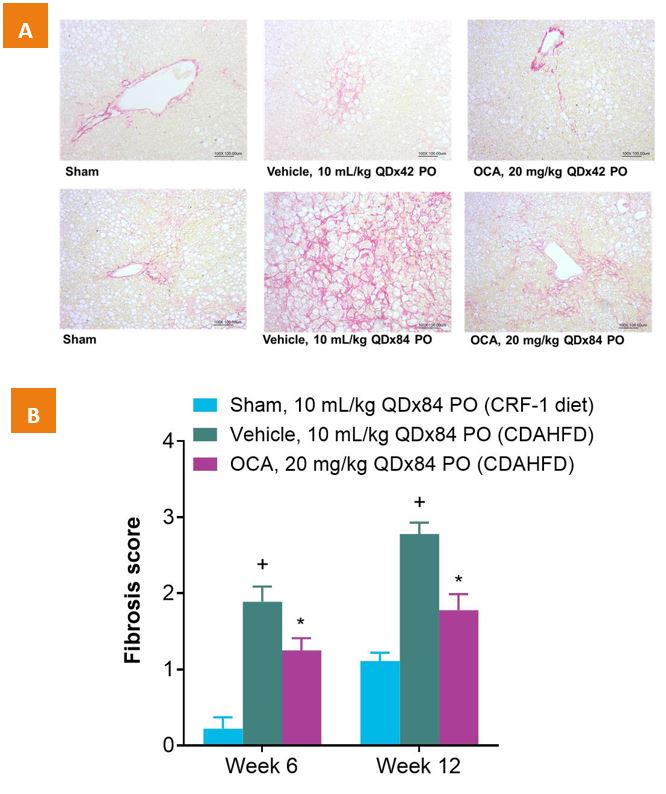
Demonstrated data for the CDAHFD Diet-Induced NASH Model in Humanized Liver Chimeric Mice. A. histopathology evaluation B. Steatosis score.
Our laboratory staff has an average of 15 years of experience in conducting in vivo pharmacology studies. We fully comply with the Guide for the Care and Use of Laboratory Animals (2011) for husbandry and animal handling and conduct studies within the facility accredited by the Association for Assessment and Accreditation of Laboratory Animal Care International (AAALAC International).
| Inflammation In Vivo Models | ||
|---|---|---|
| Model Name | Item Number | TAT |
| Nonalcoholic Steatohepatitis (NASH), CDAHFD Diet-Induced, Humanized Liver Chimeric Mouse | 546086 | 120 days |
PDS also offer CDAHFD and MCD Model in C57BL/6:
| Model Name | Item Number | TAT |
|---|---|---|
| Nonalcoholic Steatohepatitis (NASH), CDAHFD Diet-Induced | 546082 | 120 days |
| Nonalcoholic Steatohepatitis (NASH), MCD Diet-Induced | 546080 | 40 days |
- Estes C, Razavi H, Loomba R, Younossi Z, Sanyal AJ. Modeling the epidemic of nonalcoholic fatty liver disease demonstrates an exponential increase in burden of disease. Hepatology. 2018 Jan;67(1):123-133.
- Younossi ZM, Blissett D, Blissett R, Henry L, Stepanova M, Younossi Y, Racila A, Hunt S, Beckerman R. The economic and clinical burden of nonalcoholic fatty liver disease in the United States and Europe. Hepatology. 2016 Nov;64(5):1577-1586.
- Powell EE, Wong VW, Rinella M. Non-alcoholic fatty liver disease. Lancet. 2021 Jun 5;397(10290):2212-2224.
- Kisoh K, Sugahara G, Ogawa Y, Furukawa S, Ishida Y, Okanoue T, Kohara M, Tateno C. Estimating Drug Efficacy with a Diet-Induced NASH Model in Chimeric Mice with Humanized Livers. Biomedicines. 2021 Nov 9;9(11):1647.
- Márquez-Quiroga LV, Arellanes-Robledo J, Vásquez-Garzón VR, Villa-Treviño S, Muriel P. Models of nonalcoholic steatohepatitis potentiated by chemical inducers leading to hepatocellular carcinoma. Biochem Pharmacol. 2022 Jan;195:114845.
- Kisoh K, Sugahara G, Ogawa Y, Furukawa S, Ishida Y, Okanoue T, Kohara M, Tateno C. Estimating Drug Efficacy with a Diet-Induced NASH Model in Chimeric Mice with Humanized Livers. Biomedicines. 2021 Nov 9;9(11):1647.