
Thrombosis, Abdominal Aorta, Ferric Chloride-Induced
CONTACT CUSTOMER SERVICE
ADD TO FAVORITES
ADD TO PANEL
OVERVIEW
DOCUMENTS/REFERENCES
BIOLOGICAL INFORMATION
BACKGROUND INFORMATION
Thrombotic cardiovascular diseases are the most common cause of death and disability in the developed world. The ferric chloride (FeCl3) injury is a well-established technique to induce the formation of thrombi in exposed veins or artery of small and large diameter. The ferric chloride (FeCl3) induced arterial thrombosis model is widely used to study molecular mechanisms as well as the efficacy of antithrombotic agents.
ORGANISM
Rat
ASSAY INFORMATION
ASSAY TYPE
In Vivo
TESTING INFORMATION
PROCEDURE SUMMARY
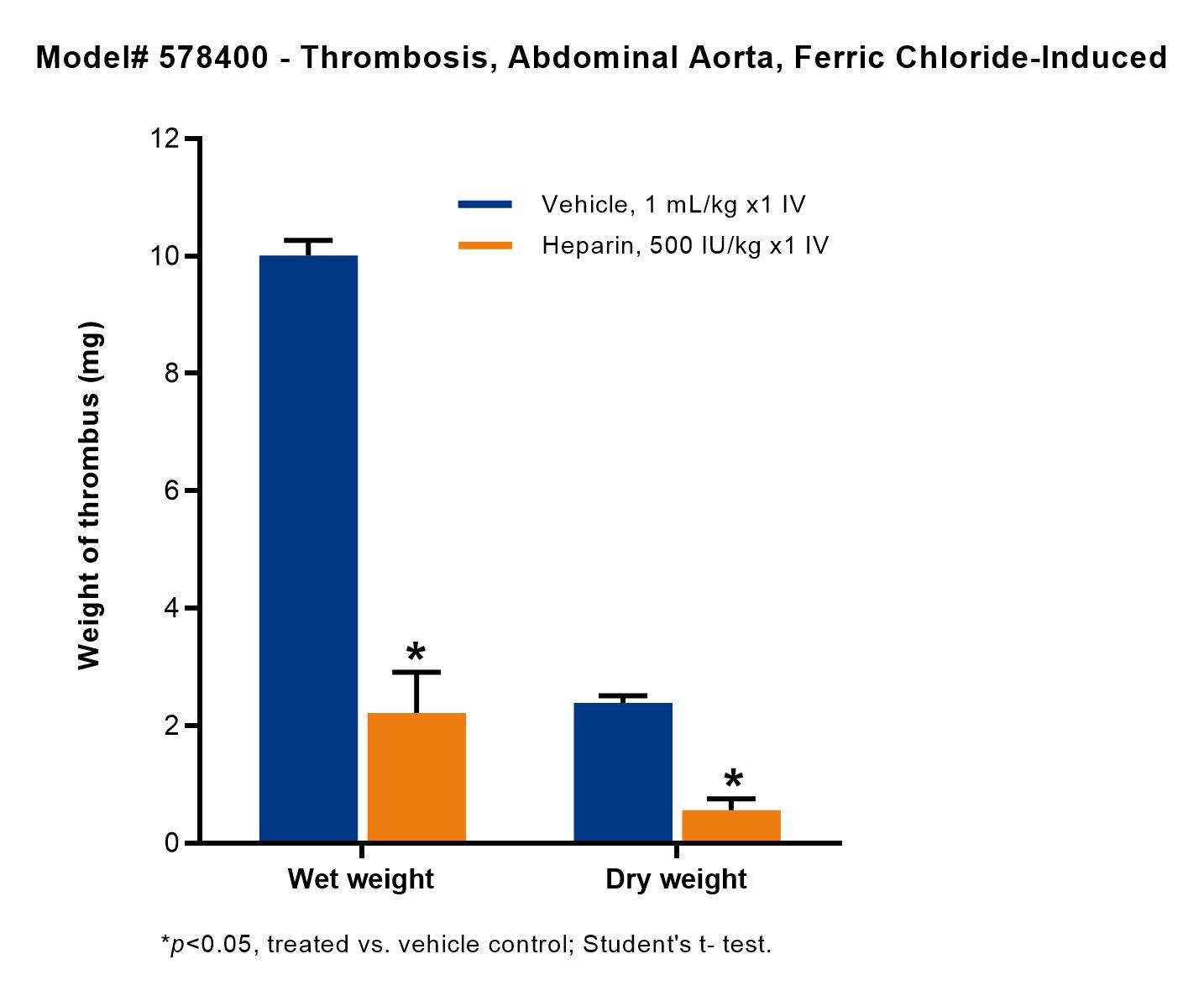
Groups of 6 male and female Sprague-Dawley (SD) rats weighing 400 ± 30 g are used. The animals are anesthetized with pentobarbital sodium (50 mg/kg i.p.) and the abdominal aorta is dissected free from surrounding tissue. Two loose ligatures are placed 1.2 cm apart around the aorta. A piece of filter paper (length: 2 cm, width: 1 cm) saturated with 50 % (w/v) ferric chloride solution (FeCl3) (100 uL) is placed between the ligatures on the surface of the artery for 15 minutes. Following removal of the filter paper, the ligatures are closed, the aorta between the ligatures is isolated and the rat is euthanized. The removed abdominal arterial section is then opened lengthwise in order to scrape out the formed thrombus which is placed on filter paper to remove water content. Its wet weight is immediately measured and then placed into a refrigerated incubator at 37°C for 24 hours in order to obtain the dry weight. Test articles and the vehicle are administered orally (PO) 1 hour before the application of ferric chloride. ANOVA followed by Dunnett's test is applied for comparison between vehicle and treatment groups. p<0.05 is considered significant. Suggested Testing: n=6/group (study design dependent). Doses may be administered PO, IV, IP and SC. Assessments available: Biomarkers and histology services may be performed upon request.
CRITERIA FOR SIGNIFICANCE
p<0.05 compared to vehicle control is considered significant activity
TURNAROUND TIME
STANDARD
30 Days
CLINICAL RELEVANCE
THERAPEUTIC AREA
Cardiovascular
ADDITIONAL INFORMATION
BRAND
PDS
TESTING LOCATION
Taiwan - Taipei
OTHER INFORMATION
We will readily accommodate client-specified alterations. These studies are performed at our AAALAC accredited BSL-2 laboratory in Taipei, Taiwan. All aspects of this work are performed in general accordance with the Guide for the Care and Use of laboratory animals (National Academy Press, Washington, DC, 2011). The study protocol was approved by the Pharmacology Discovery Services IACUC and is performed with the oversight of veterinarians to assure the humane treatment of laboratory animals.
ITEM DOES NOT EXIST
© Copyright 2026, Pharmacology Discovery Services – Privacy Policy | Cookie Notice | Cookie Preferences