
Pulmonary, Lipopolysaccharide (LPS)-Induced Neutrophilia, Mouse
CONTACT CUSTOMER SERVICE
ADD TO FAVORITES
ADD TO PANEL
OVERVIEW
DOCUMENTS/REFERENCES
BIOLOGICAL INFORMATION
BACKGROUND INFORMATION
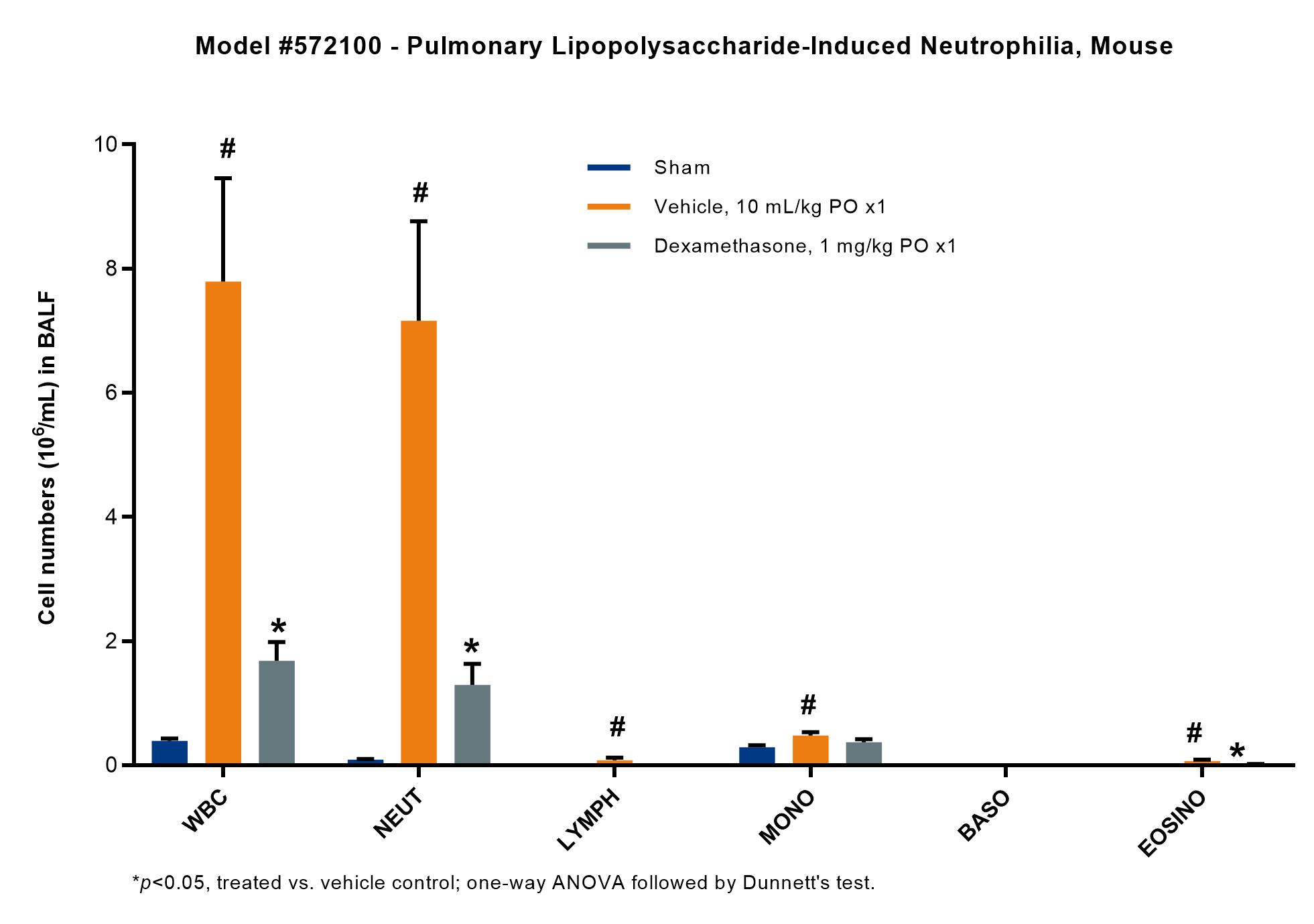
Pulmonary neutrophil activation by LPS is used as an in vivo model for allergic asthma, bronchitis and/or chronic obstructive pulmonary disease (COPD). LPS initiates neutrophil activation and release of proinflammatory cytokines, TNF and IL-6, followed by neutrophil infiltration into the bronchoalveolae mediated by chemokines such as IL-8 and CXCL5. Subsequent localized pulmonary injury and inflammation is then further exacerbated by activation of p38 kinase/cJun kinase pathways, metalloproteinases, leukotreines and iNOS resulting in pulmonary congestion.
ORGANISM
Mouse
ASSAY INFORMATION
ASSAY TYPE
In Vivo
TESTING INFORMATION
PROCEDURE SUMMARY
Male BALB/c mice weighing 20 to 22 g are used. Test substance is administered orally to a group of 5 animals 2 hours before challenge with ~80 µg/kg of E. Coli lipopolysaccharide (LPS in sterile saline, 2 µg in 20 µL per mouse intratracheally). Mice are anaesthetized by pentobarbital (80 mg/kg, IP) 24 hours after LPS challenge, 0.25 mL of phosphate buffered saline (PBS) is administered twice through a tracheal cannula after which about 0.3 mL of bronchoalveolar lavage fluid (BALF) is obtained. Differential cell counts are determined by an automatic hematology analyzer (Sysmex, XT-2000iV), total cell number/mL and % neutrophils in BALF are then determined. One-way ANOVA followed by Dunnett’s test is used to determine possible significant difference at p<0.05. Suggested Testing: n=5/group (study design dependent). Anti-inflammatory effects assessed at an initial dose of 100 mg/kg. Dosing volume at 10 mL/kg.
CRITERIA FOR SIGNIFICANCE
Significant difference was determined at P < 0.05
TURNAROUND TIME
STANDARD
20 Days
CLINICAL RELEVANCE
THERAPEUTIC AREA
Pulmonology
ADDITIONAL INFORMATION
BRAND
PDS
TESTING LOCATION
Taiwan - Taipei
OTHER INFORMATION
We will readily accommodate client-specified alterations. These studies are performed at our AAALAC accredited BSL-2 laboratory in Taipei, Taiwan. All aspects of this work are performed in general accordance with the Guide for the Care and Use of laboratory animals (National Academy Press, Washington, DC, 2011). The study protocol was approved by the Pharmacology Discovery Services IACUC and is performed with the oversight of veterinarians to assure the humane treatment of laboratory animals.
ITEM DOES NOT EXIST
© Copyright 2026, Pharmacology Discovery Services – Privacy Policy | Cookie Notice | Cookie Preferences