
Inflammation, Delayed-Type Hypersensitivity (DTH), Acute
CONTACT CUSTOMER SERVICE
ADD TO FAVORITES
ADD TO PANEL
OVERVIEW
DOCUMENTS/REFERENCES
BIOLOGICAL INFORMATION
BACKGROUND INFORMATION
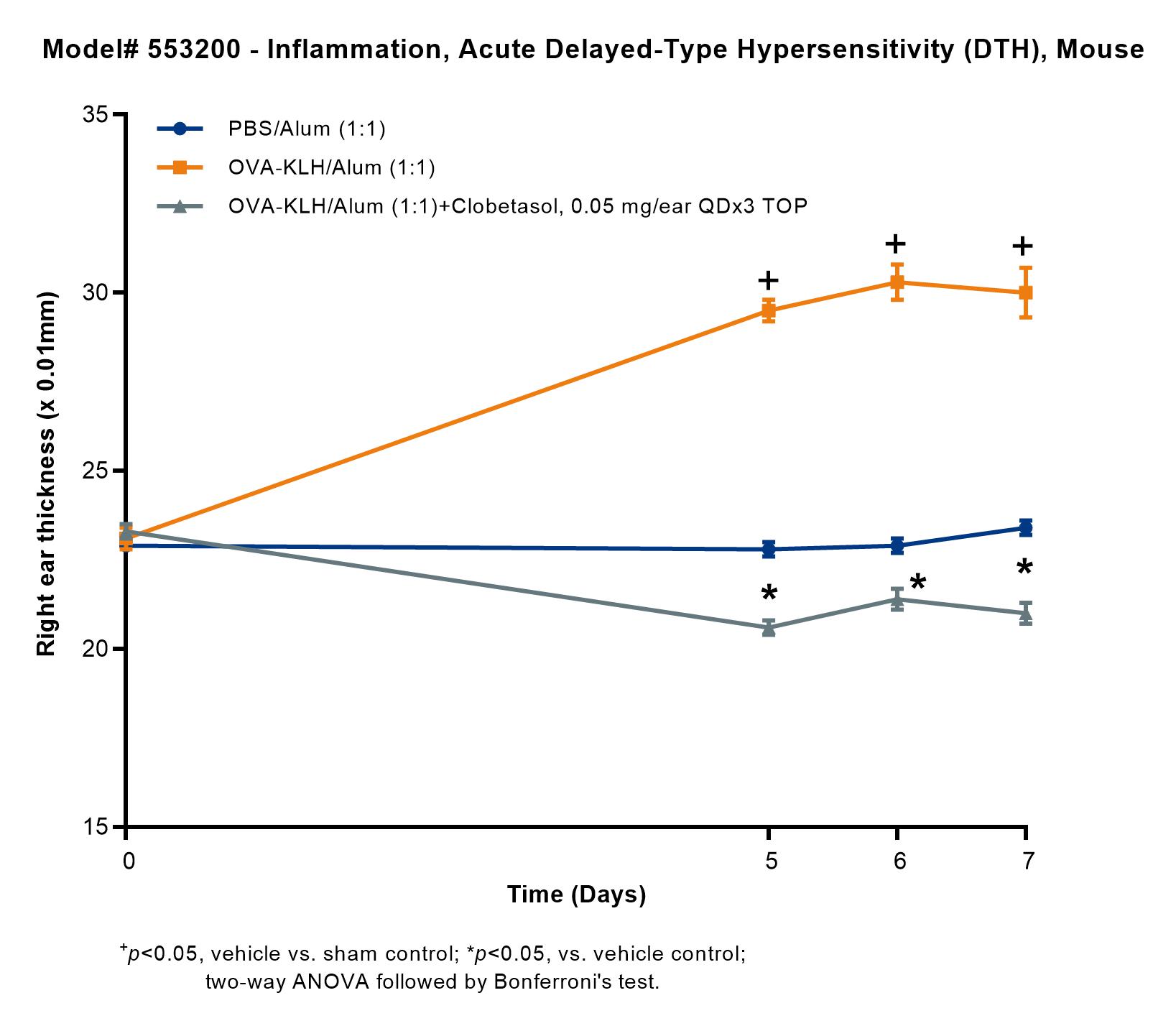
Delayed-type hypersensitivity (DTH) reaction, also known as type IV hypersensitivity reaction, is a useful approach for evaluating cell-mediated immune responses associated with CD4⁺ or CD8⁺ T cell reactivity. The OVA-KLH/Alum induced delayed-type hypersensitivity (DTH) mouse model is commonly used to study the mechanisms of skin inflammation and evaluate therapeutic efficacy.
ORGANISM
Mouse
ASSAY INFORMATION
ASSAY TYPE
In Vivo
TESTING INFORMATION
PROCEDURE SUMMARY
Male BALB/c mice weighing 22 ± 2 g are randomly divided into groups of 8 each. On Day 0, mice are sensitized by intraperitoneal (i.p.) co-injection of OVA (50 µg) and KLH (50 µg) in Alum in 100 µL volume, and re-challenged on Day 4 under anesthesia with intradermal (i. d.) injection to the right ear of OVA (50 µg) and KLH (50 µg) without Alum in a volume of 10 µL. Test article, vehicle or reference compound Clobetasol propionate cream, is given once daily (QD) topically onto the right ear starting 24 hours before antigen challenge through Day 5 for a total of 3 days. On Days 0, 5, 6 and 7, ear swelling in both ears is measured by a dial thickness micrometer gauge. At termination on Day 7, both ears are punched with 0.8 cm diameter punch and weighed; the punched ear tissues are flash frozen, stored at -20°C for further analyses. Doses may be administered PO, IV, IP and SC. Suggested Testing: n=8/group (study design dependent).
CRITERIA FOR SIGNIFICANCE
p<0.05 compared to vehicle control is considered significant activity
TURNAROUND TIME
STANDARD
35 Days
CLINICAL RELEVANCE
THERAPEUTIC AREA
Inflammation/Allergy
ADDITIONAL INFORMATION
BRAND
PDS
TESTING LOCATION
Taiwan - Taipei
OTHER INFORMATION
We will readily accommodate client-specified alterations. These studies are performed at our AAALAC accredited BSL-2 laboratory in Taipei, Taiwan. All aspects of this work are performed in general accordance with the Guide for the Care and Use of laboratory animals (National Academy Press, Washington, DC, 2011). The study protocol was approved by the Pharmacology Discovery Services IACUC and is performed with the oversight of veterinarians to assure the humane treatment of laboratory animals.
ITEM DOES NOT EXIST
© Copyright 2026, Pharmacology Discovery Services – Privacy Policy | Cookie Notice | Cookie Preferences