
Gastrointestinal Motility, Rat
CONTACT CUSTOMER SERVICE
ADD TO FAVORITES
ADD TO PANEL
OVERVIEW
DOCUMENTS/REFERENCES
BIOLOGICAL INFORMATION
BACKGROUND INFORMATION
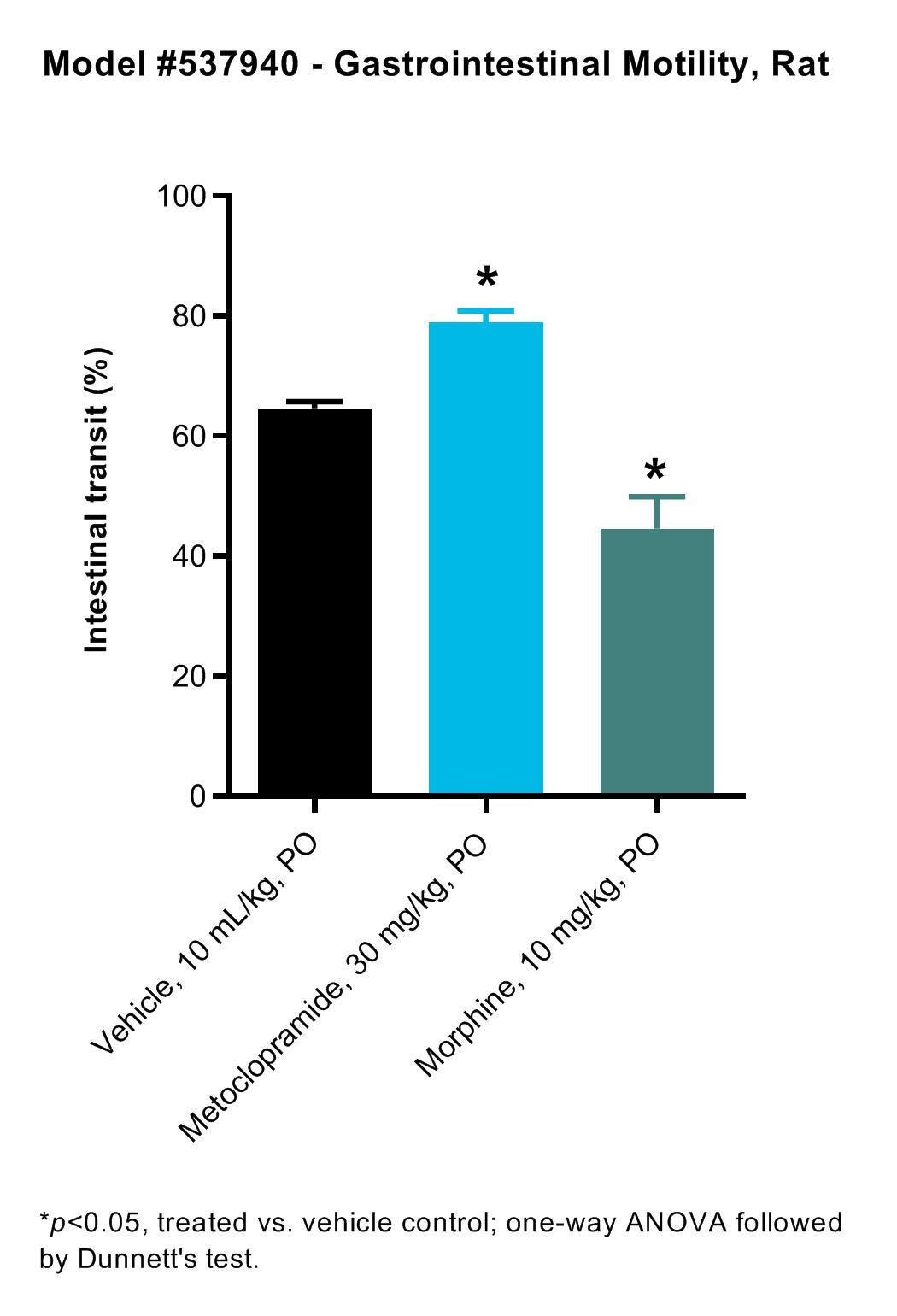
Changes of gastrointestinal motility, which are important effect related to the food digestion or drug absorption in the gastrointestinal tract. Morphine and the opioid peptides can effectively reduce gastric emptying and gastrointestinal transit. Gastrointestinal motility is commonly used to study the mechanisms of intestinal transit with the drug.
ORGANISM
Rat
ASSAY INFORMATION
ASSAY TYPE
In Vivo
TESTING INFORMATION
PROCEDURE SUMMARY
Test article is administered to groups of 6 male Wistar rats weighing 200 ± 20 g, fasted with free access to water for 16 hours prior to testing. At 60 minutes post dosing, the animals are given a suspension of 5% charcoal in 10% gum arabic solution (2 ml/animal p.o.) and sacrificed 15 minutes later. The intestine is removed and the length of the gut in cm (GL) as well as extent of charcoal movement from the pylorus to the beginning of the charcoal column in cm (CP) is measured. ANOVA followed by Dunnett's test is applied for comparison between vehicle and treatment groups. p<0.05 is considered significant. Suggested Testing: n=6/group (study design dependent). Doses may be administered PO, IV, IP and SC.
CRITERIA FOR SIGNIFICANCE
p<0.05 compared to vehicle control is considered significant activity
TURNAROUND TIME
STANDARD
20 Days
CLINICAL RELEVANCE
THERAPEUTIC AREA
Gastroenterology
ADDITIONAL INFORMATION
BRAND
PDS
TESTING LOCATION
Taiwan - Taipei
OTHER INFORMATION
We will readily accommodate client-specified alterations. These studies are performed at our AAALAC accredited BSL-2 laboratory in Taipei, Taiwan. All aspects of this work are performed in general accordance with the Guide for the Care and Use of laboratory animals (National Academy Press, Washington, DC, 2011). The study protocol was approved by the Pharmacology Discovery Services IACUC and is performed with the oversight of veterinarians to assure the humane treatment of laboratory animals.
ITEM DOES NOT EXIST
© Copyright 2026, Pharmacology Discovery Services – Privacy Policy | Cookie Notice | Cookie Preferences