
Depression, Tail Suspension
CONTACT CUSTOMER SERVICE
ADD TO FAVORITES
ADD TO PANEL
OVERVIEW
DOCUMENTS/REFERENCES
BIOLOGICAL INFORMATION
BACKGROUND INFORMATION
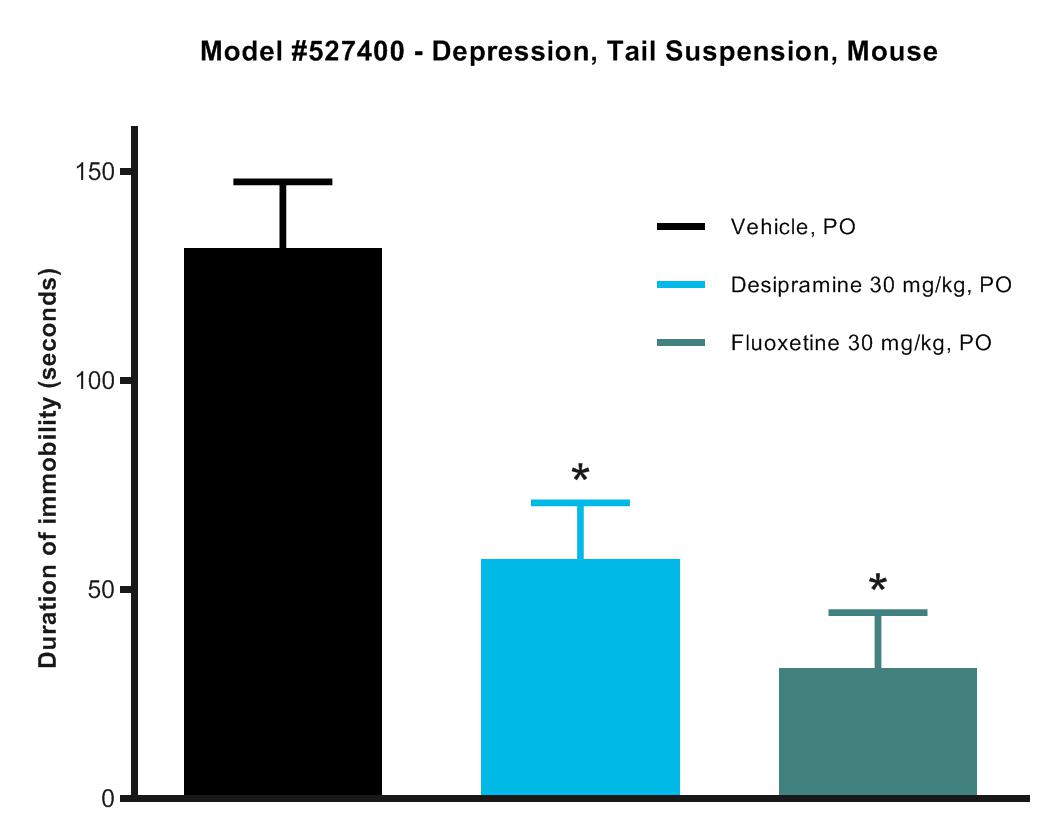
The tail suspension test has become one of the most widely used models for evaluating antidepressant-like activity in mice. The test is based on the fact that animals subjected to the short-term, inescapable stress of being suspended by their tail, will show an immobile posture. Various antidepressant medications reverse the immobility and promote the occurrence of escape-related behaviour.
ORGANISM
Mouse
ASSAY INFORMATION
ASSAY TYPE
In Vivo
TESTING INFORMATION
PROCEDURE SUMMARY
Test substance is administered orally (PO) to a group of 8 ICR male mice weighing 23 ± 3 grams (g) 60 minutes before testing. For the test, mice are suspended on the edge of a shelf 58 cm above a table top by adhesive tape placed approximately 1 cm from the tip of the tail. The duration of immobility is recorded for a period of 5 minutes (2 to 7 minutes after tail suspension). One-way ANOVA followed by Dunnett’s test is applied for a comparison between vehicle and treated groups. Differences are considered significant at p<0.05. Suggested Testing: n=8/group (study design dependent). Antidepressant activity assessed at an initial dose of 30 mg/kg. Dosing volume at 10 mL/kg.
CRITERIA FOR SIGNIFICANCE
Reduction of the immobility time. One-way ANOVA followed by Dunnett’s test is applied for a comparison between vehicle and treated groups.
TURNAROUND TIME
STANDARD
20 Days
CLINICAL RELEVANCE
THERAPEUTIC AREA
CNS/Addiction/Pain
ADDITIONAL INFORMATION
BRAND
PDS
TESTING LOCATION
Taiwan - Taipei
OTHER INFORMATION
We will readily accommodate client-specified alterations. These studies are performed at our AAALAC accredited BSL-2 laboratory in Taipei, Taiwan. All aspects of this work are performed in general accordance with the Guide for the Care and Use of laboratory animals (National Academy Press, Washington, DC, 2011). The study protocol was approved by the Pharmacology Discovery Services IACUC and is performed with the oversight of veterinarians to assure the humane treatment of laboratory animals.
ITEM DOES NOT EXIST
© Copyright 2026, Pharmacology Discovery Services – Privacy Policy | Cookie Notice | Cookie Preferences