
Chemotherapy-Induced Neuropathic Pain, Oxaliplatin
CONTACT CUSTOMER SERVICE
ADD TO FAVORITES
ADD TO PANEL
OVERVIEW
DOCUMENTS/REFERENCES
BIOLOGICAL INFORMATION
BACKGROUND INFORMATION
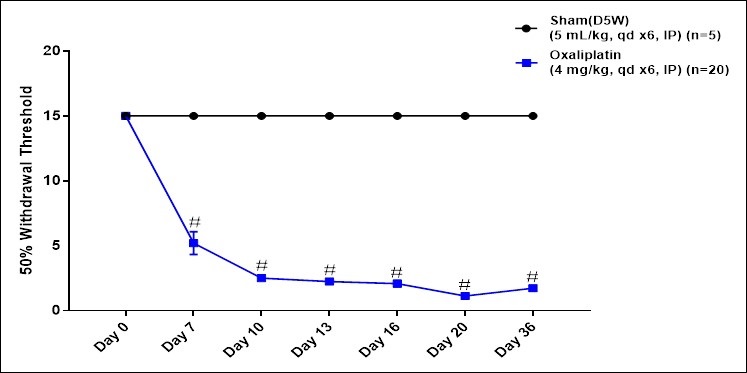
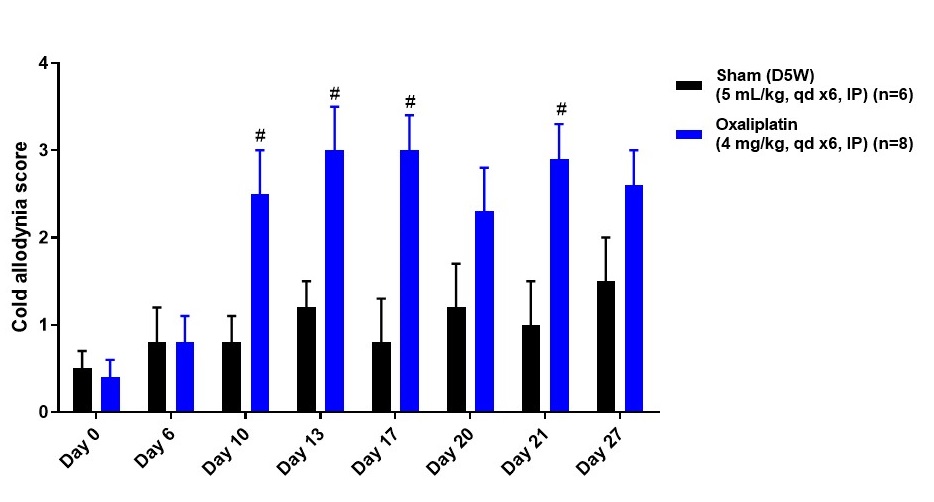
Chemotherapy-induced peripheral neuropathy is one of the most serious complications associated with anticancer drugs. It is an important cause of pain during cancer treatment and is a common pain in the cancer survivor. The presence of chemotherapy-induced pain is noted as hyperalgesia (increased response to noxious stimuli) or allodynia (nociceptive response to normally innocuous stimuli). In the model described below, the sharp withdrawal of the hind paw to light mechanical stimuli indicates the presence of mechanical allodynia. The response to a cold stimulus can also be assessed to measure cold allodynia.
ORGANISM
Rat
ASSAY INFORMATION
ASSAY TYPE
In Vivo
TESTING INFORMATION
PROCEDURE SUMMARY
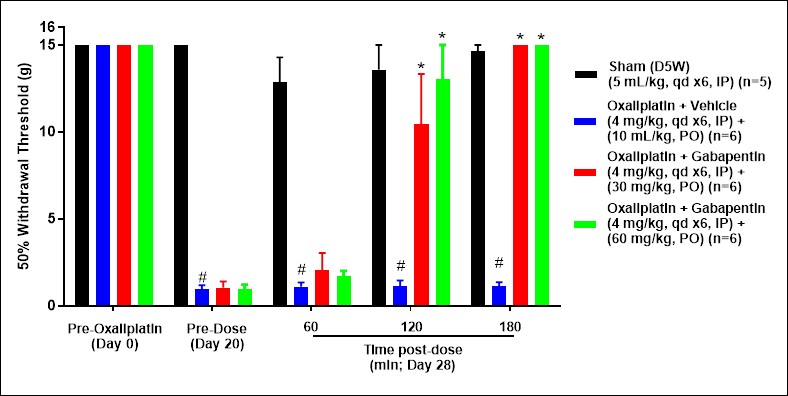
Groups of 10 male Sprague Dawley (SD) rats weighing 180 ± 20 grams (g) are employed. Mechanical allodynia is induced by one dose of Oxaliplatin 4 mg/kg, intraperitoneal (IP) administered biweekly for a total of 6 injections on Days 0, 3, 7, 10, 14 and 17. The rats are preselected (clear presence of allodynia) for experimentation only if the nociceptive response 21 days after the Oxaliplatin injections (pre-treatment), is reduced by 10 g of force relative to the response of the individual paw before the Oxaliplatin challenge. Test substance and vehicle are administered orally (PO) to groups of 10 animals. At selected post-dose testing time(s), the level of mechanical allodynia is assessed again to obtain the mechanical allodynia values (post-treatment). Cold allodynia is offered as an optional add-on behavioral measurement for the Oxaliplatin induced neuropathic pain model. One-way ANOVA followed by Dunnett's test is applied for comparison between vehicle and treatment groups. Activity is considered at p<0.05. Suggested Testing: n=10/group (study design dependent). Analgesic activity assessed at an initial dose of 100 mg/kg. Dosing volume at 10 mL/kg.
CRITERIA FOR SIGNIFICANCE
Reduction of Oxaliplatin-induced allodynia. One-way ANOVA followed by Dunnett's test is applied for comparison between vehicle control and treated groups.
TURNAROUND TIME
STANDARD
45 Days
CLINICAL RELEVANCE
THERAPEUTIC AREA
CNS/Addiction/Pain
ADDITIONAL INFORMATION
BRAND
PDS
TESTING LOCATION
Taiwan - Taipei
OTHER INFORMATION
We will readily accommodate client-specified alterations. These studies are performed at our AAALAC accredited BSL-2 laboratory in Taipei, Taiwan. All aspects of this work are performed in general accordance with the Guide for the Care and Use of laboratory animals (National Academy Press, Washington, DC, 2011). The study protocol was approved by the Pharmacology Discovery Services IACUC and is performed with the oversight of veterinarians to assure the hWe will readily accommodate client-specified alterations. These studies are performed at our AAALAC accredited BSL-2 laboratory in Taipei, Taiwan. All aspects of this work are performed in general accordance with the Guide for the Care and Use of laboratory animals (National Academy Press, Washington, DC, 2011). The study protocol was approved by the Pharmacology Discovery Services IACUC and is performed with the oversight of veterinarians to assure the humane treatment of laboratory animals.
ITEM DOES NOT EXIST
© Copyright 2026, Pharmacology Discovery Services – Privacy Policy | Cookie Notice | Cookie Preferences