
Allergy, Passive Cutaneous Anaphylaxis (PCA), Rat
CONTACT CUSTOMER SERVICE
ADD TO FAVORITES
ADD TO PANEL
OVERVIEW
DOCUMENTS/REFERENCES
BIOLOGICAL INFORMATION
BACKGROUND INFORMATION
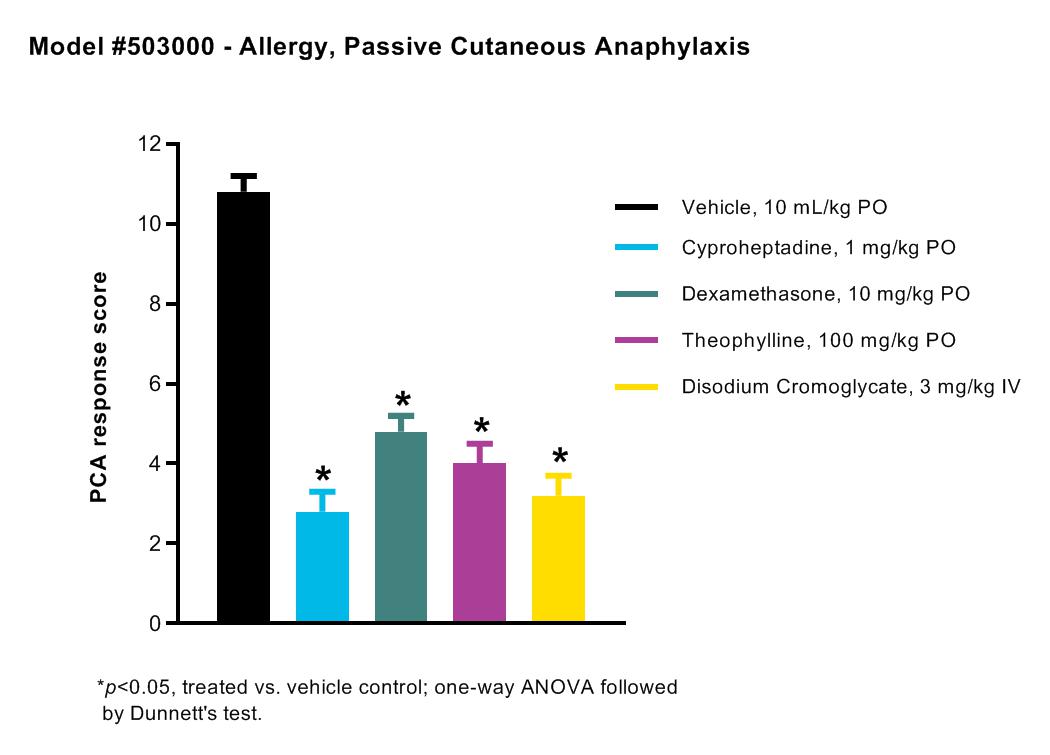
Passive cutaneous anaphylaxis in rat is an immediate type immune reaction. Through passive intradermal immunization with rat anti-ovalbumin serum, subsequent challenge with ovalbumin antigen results in an antigen-antibody (IgE) mediated release of mediators from the dermal mast cells. The mediator, primarily histamine, causes local vasodilatation, increase in vascular permeability and leakage of plasma. Inhibition of the PCA reaction suggests possible ant-allergic and/or antihistaminic activity.
ORGANISM
Rat
ASSAY INFORMATION
ASSAY TYPE
In Vivo
TESTING INFORMATION
PROCEDURE SUMMARY
Test articles are administered orally (PO) to groups of 6 male Wistar rats weighing 80 ± 20 g passively sensitized 16 hours earlier by intradermal injection of reaginic (IgE) anti-ovalbumin serum (0.05 mL) on two spots of the dorsal surface. Within 60 minutes after test article administration, animals are challenged IV with a mixture of ovalbumin (1 mg) and Evans blue dye (5 mg) and sacrificed 30 minutes later. The two measured wheal diameters are averaged for each animal and scored 0 if <0.05 cm, 1 if >0.05-0.2 cm, 2 if >0. 2-0.4 cm, 3 if >0.4-0.6 cm, 4 if >0.6-0.8 cm, 5 if >0.8-1.2 cm and 6 if >1.2 cm. The maximum possible score for each animal totals 2 x 6 = 12.
CRITERIA FOR SIGNIFICANCE
p<0.05 compared to vehicle control is considered significant activity
TURNAROUND TIME
STANDARD
20 Days
CLINICAL RELEVANCE
THERAPEUTIC AREA
Inflammation/Allergy
ADDITIONAL INFORMATION
BRAND
PDS
TESTING LOCATION
Taiwan - Taipei
OTHER INFORMATION
We will readily accommodate client-specified alterations. These studies are performed at our AAALAC accredited BSL-2 laboratory in Taipei, Taiwan. All aspects of this work are performed in general accordance with the Guide for the Care and Use of laboratory animals (National Academy Press, Washington, DC, 2011). The study protocol was approved by the Pharmacology Discovery Services IACUC and is performed with the oversight of veterinarians to assure the humane treatment of laboratory animals.
ITEM DOES NOT EXIST
© Copyright 2026, Pharmacology Discovery Services – Privacy Policy | Cookie Notice | Cookie Preferences