
Xenograft, Bladder, UM-UC-3
CONTACT CUSTOMER SERVICE
ADD TO FAVORITES
ADD TO PANEL
OVERVIEW
DOCUMENTS/REFERENCES
BIOLOGICAL INFORMATION
BACKGROUND INFORMATION
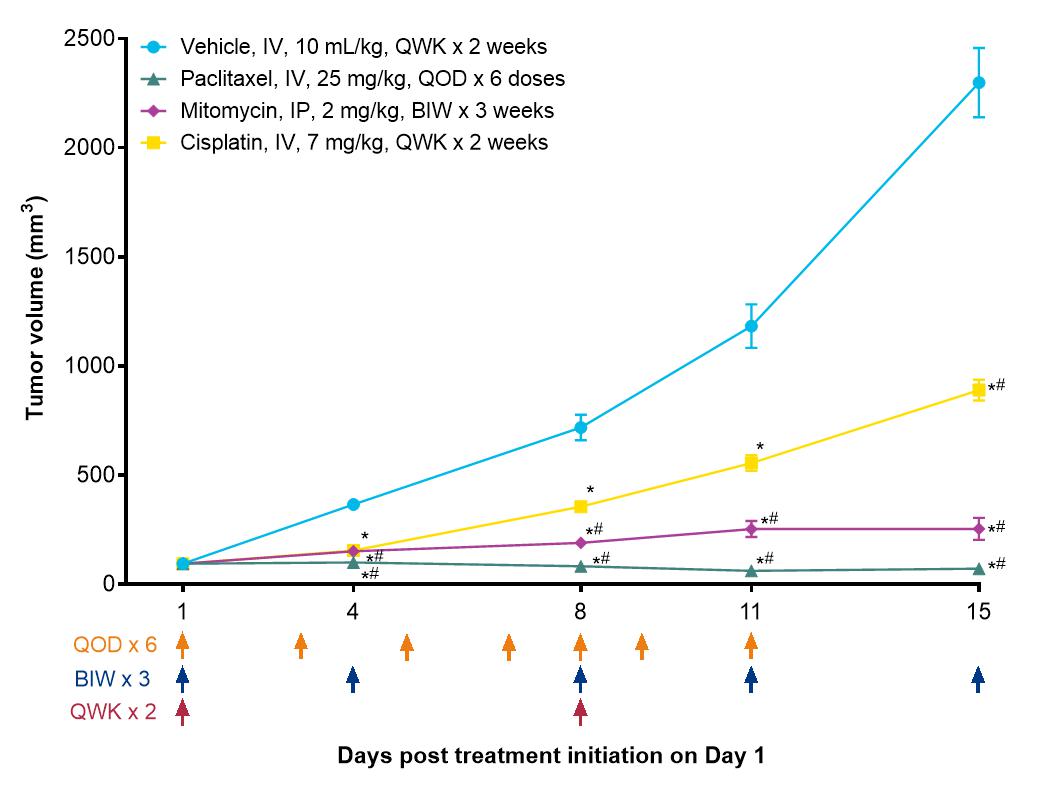
The human bladder carcinoma UM-UC-3 xenograft model is used to evaluate therapeutic efficacy of investigational antineoplastic in immune-compromised mice.
ORGANISM
Mouse
ASSAY INFORMATION
ASSAY TYPE
In Vivo
TESTING INFORMATION
PROCEDURE SUMMARY
Specific-pathogen-free (SPF) female SCID mice bred in an animal isolator (IVC racks) under SPF conditions at 22 ± 2°C are used. Viable human bladder carcinoma UM-UC-3 cells, at 5 x 10⁶ per mouse with Matrigel, are injected subcutaneously into the right flank of each experimental animal. Dose administrations are initiated when grouped mean tumor volumes reach 80-120 mm³ (Day 1). Tumor volumes and body weights are measured and recorded twice weekly over the course of the study period. Study period can be up to 2 weeks or when the mean tumor volume reaches 2000 mm³. The tumor volume, measured with a caliper, is calculated according to prolate ellipsoid formula: Tumor volume = length x (width)² x 0.5. Antitumor effect is expressed as %T/C by dividing the tumor volumes from treatment groups (Tₙ) with the control groups (Cₙ) and multiplied by 100; where Tₙ = mean tumor volume of treated group on Day “n”, and Cₙ = mean tumor volume of control group on Day “n”.
CRITERIA FOR SIGNIFICANCE
A %T/C value ≤ 42% or significant difference (p < 0.05) in tumor volume.
TURNAROUND TIME
STANDARD
50 Days
CLINICAL RELEVANCE
THERAPEUTIC AREA
Oncology/Immuno-Oncology
ADDITIONAL INFORMATION
BRAND
PDS
TESTING LOCATION
Taiwan - Taipei
OTHER INFORMATION
We will readily accommodate client-specified alterations. These studies are performed at our AAALAC accredited laboratory in Taipei, Taiwan. All aspects of this work are performed in general accordance with the Guide for the Care and Use of laboratory animals (National Academy Press, Washington, DC, 2011). The study protocol was approved by the Pharmacology Discovery Services IACUC and is performed with the oversight of veterinarians to assure the humane treatment of laboratory animals.
ITEM DOES NOT EXIST
© Copyright 2026, Pharmacology Discovery Services – Privacy Policy | Cookie Notice | Cookie Preferences