
Scleroderma, Bleomycin-induced
CONTACT CUSTOMER SERVICE
ADD TO FAVORITES
ADD TO PANEL
OVERVIEW
DOCUMENTS/REFERENCES
BIOLOGICAL INFORMATION
BACKGROUND INFORMATION
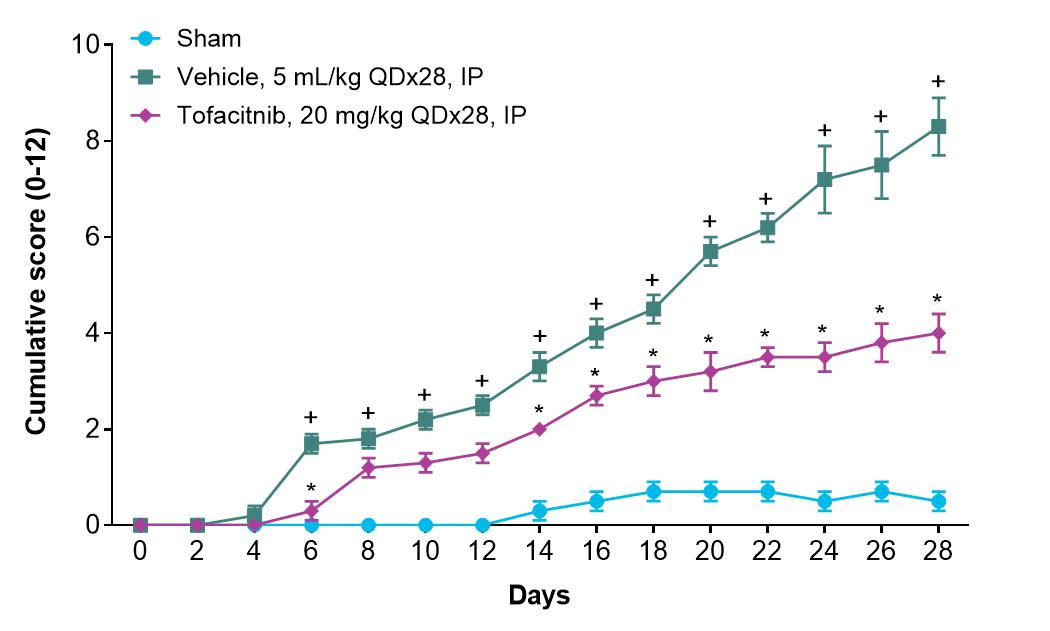
Systemic sclerosis (SSc) is a multisystem autoimmune disease characterized by initial vascular injury, activation of the immune system, autoimmunity, and resultant fibrosis. Repetitive intradermal injections of the cytotoxic agent bleomycin trigger progressive skin thickening in this model. Bleomycin (BLM)-induced skin fibrosis model is a well-characterized disease model commonly used to study anti-inflammatory and anti-fibrotic efficacy of test articles for SSc.
ORGANISM
Mouse
ASSAY INFORMATION
ASSAY TYPE
In Vivo
TESTING INFORMATION
PROCEDURE SUMMARY
Groups of 8 male C57BL/6 mice at 7 weeks of age are used. Bleomycin is dissolved in phosphate-buffered saline (PBS) at the concentration of 1 mg/mL and sterilized by filtration. On the day of study (Day 0), the animals are anesthetized with isoflurane and received intradermal injection (ID) of BLM (100 μg/100 μL/mouse) or PBS into the pre-shaved back with a 29-gauge needle every other day for 4 weeks. The injection sites are located at the corners of a 1.5 cm²-square shaved area and are used in rotation. Vehicle and test articles are injected intraperitoneally (IP) once daily from Day 0 to Day 27 for 4 weeks. Clinical observations* including body weight and mortality, will be monitored every other day. On Day 28, mice are anesthetized by pentobarbital (80 mg/kg, IP), and 0.5 mL of PBS is administered twice through a tracheal cannula, after which about 0.6 mL of bronchoalveolar lavage fluid (BALF) is obtained. Total cell counts and differential cell counts in BALF are determined by an automatic hematology analyzer. Skins at the lesion sites from all animals are collected and weighed. The skins are fixed in 10% formalin for histopathological analysis (H&E staining) to detect inflammatory cell infiltration, fibrosis, and dermal thickness. Additional analyses can also be requested, including lung histopathology, hydroxyproline content in the skin and lung, cytokine measurement, etc.
CRITERIA FOR SIGNIFICANCE
ANOVA and Dunnett’s test are used to ascertain the difference between vehicle control and treated mice. Significance is set at p<0.05 level.
TURNAROUND TIME
STANDARD
50 Days
CLINICAL RELEVANCE
THERAPEUTIC AREA
Inflammation/Allergy
ADDITIONAL INFORMATION
BRAND
PDS
TESTING LOCATION
Taiwan - Taipei
OTHER INFORMATION
We will readily accommodate client-specified alterations. These studies are performed at our AAALAC-accredited BSL-2 laboratory in Taipei, Taiwan. All aspects of this work are performed in general accordance with the Guide for the Care and Use of laboratory animals (National Academy Press, Washington, DC, 2011). The study protocol was approved by the Pharmacology Discovery Services IACUC and is performed with the oversight of veterinarians to assure the humane treatment of laboratory animals.
ITEM DOES NOT EXIST
© Copyright 2026, Pharmacology Discovery Services – Privacy Policy | Cookie Notice | Cookie Preferences