
Multiple Sclerosis, Experimental Autoimmune Encephalomyelitis (EAE), Myelin Oligodendrocyte Glycoprotein (MOG)-induced
CONTACT CUSTOMER SERVICE
ADD TO FAVORITES
ADD TO PANEL
OVERVIEW
DOCUMENTS/REFERENCES
BIOLOGICAL INFORMATION
BACKGROUND INFORMATION
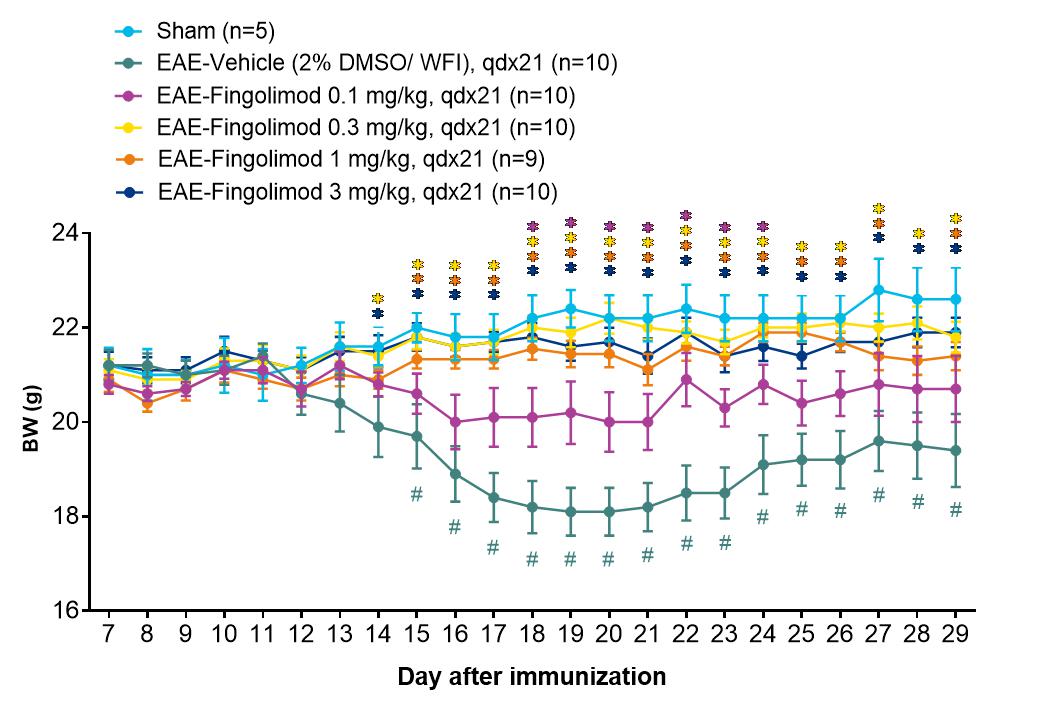
Experimental autoimmune encephalomyelitis (EAE) is the most common animal model for multiple sclerosis (MS), both sharing many clinical and pathophysiological features. The myelin oligodendrocyte glycoprotein (MOG) 35-55 peptides have been used for the induction of EAE in C57BL/6 mice, resulting in an ascending paralysis caused by autoreactive immune cells in the central nervous system. The MOG-induced EAE has been used extensively for studying the pathogenesis and immunomechanisms of MS and for evaluating the efficacy of MS drug candidates.
ORGANISM
Mouse
ASSAY INFORMATION
ASSAY TYPE
In Vivo
TESTING INFORMATION
PROCEDURE SUMMARY
Groups of 10 each female C57BL/6 mice at 10 ± 2 weeks of age are used. All animals, except those in sham group, are immunized for the induction of EAE by receiving MOG 35-55/ CFA emulsion via subcutaneous (SC) injection on Day 0, as well as pertussis toxin (PTX) injected intraperitonally (IP) on Day 0 and Day 1. Animals in the Sham group receive PBS injections, without MOG 35-55 and PTX inductions. Vehicle and test article are given by orally (PO) once daily for a total of 21 days (QDx21; Day 0 to Day 20). The positive control, Fingolimod at 3 mg/kg, is administered PO concurrently. The body weight and the clinical score are recorded daily during the study period, starting from Day 7. At termination on Day 29, animals are sacrificed after the disease scoring and body weight measurement. Blood is collected for hematology, and some blood can be processed to plasma or serum and stored frozen for further analysis. Immediately after the blood collection, brain and spinal cord can also be harvested for histopathological evaluation (H&E and/or LFB stain). Other measurements that can also be requested include behavioral testing, flow cytometric analyses, IHC, etc. All values represent mean ± SEM. Two-way ANOVA followed by Bonferroni's test is applied for comparison between vehicle and treatment groups. The p<0.05 is considered significant. Suggested Testing: n=10/group (study design dependent). Suggested Testing: n=5/group (study design dependent). Effects on EAE assessed at an ini
CRITERIA FOR SIGNIFICANCE
Changes in EAE diseases. One-way ANOVA followed by Dunnett's test is applied for comparison between vehicle control and treated groups.
TURNAROUND TIME
STANDARD
50 Days
CLINICAL RELEVANCE
THERAPEUTIC AREA
Inflammation/Allergy
ADDITIONAL INFORMATION
BRAND
PDS
TESTING LOCATION
Taiwan - Taipei
OTHER INFORMATION
We will readily accommodate client-specified alterations. These studies are performed at our AAALAC accredited BSL-1 laboratory in Taipei, Taiwan. All aspects of this work are performed in general accordance with the Guide for the Care and Use of laboratory animals (National Academy Press, Washington, DC, 2011). The study protocol was approved by the Pharmacology Discovery Services IACUC and is performed with the oversight of veterinarians to assure the humane treatment of laboratory animals.
ITEM DOES NOT EXIST
© Copyright 2026, Pharmacology Discovery Services – Privacy Policy | Cookie Notice | Cookie Preferences