
Ex Vivo Immune Response Assays - Th1, Th2, and Th17 Cytokine Panels
CONTACT CUSTOMER SERVICE
ADD TO FAVORITES
ADD TO PANEL
OVERVIEW
DOCUMENTS/REFERENCES
BIOLOGICAL INFORMATION
BACKGROUND INFORMATION
Ex vivo immune response assays are a suite of assays that can be used and also customized to evaluate the effects of a test article on the immune responses. Measurements of cytokines in cell culture supernatants, cell proliferation, or Th1, Th2, and Th17 cell responses are widely used to study immune responses. We offer a variety of ex vivo assays for evaluating the efficacy of test articles on these immune responses.
ORGANISM
Mouse
ASSAY INFORMATION
ASSAY TYPE
Functional
TESTING INFORMATION
PROCEDURE SUMMARY
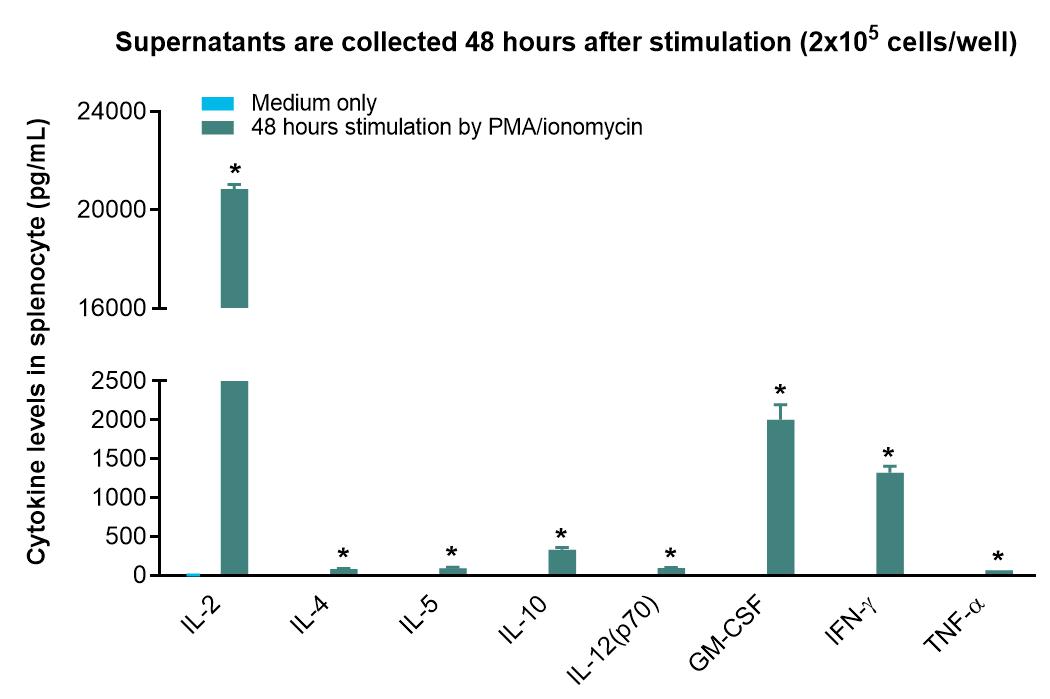
Spleens or lymph nodes are harvested from mice and crushed through a 70-μm strainer with the plunger of a 3 mL syringe to obtain a single cell suspension. The red blood cells are lysed by ACK buffer. After the washing step, cells are adjusted maximally to 2×10⁶ cells/mL. Cells are seeded in a 96-well plate at a density of 2x10⁵ cells/well in 200 μL of culture medium and Phorbol 12-myristate 13-acetate (PMA, 50 ng/mL) / ionomycin (500 ng/mL) or other antigens are added to the plate for 48 hours in a 37°C, 5% CO2 incubator. Supernatants are collected and analyzed 48 hours after stimulation for the measurement of cytokines, including IL-2, TNF-α, and IFN- γ (Th1), IL-4, IL-5, and IL-10 (Th2), and IL-17A (Th17) using Luminex kits. Other culture conditions or other cytokines can also be requested.
CRITERIA FOR SIGNIFICANCE
ANOVA and Dunnett's test are used to ascertain the difference between vehicle control and treated mice. Significance is set at p<0.05 level.
TURNAROUND TIME
STANDARD
15 Days
CLINICAL RELEVANCE
THERAPEUTIC AREA
Inflammation/Allergy
ADDITIONAL INFORMATION
BRAND
PDS
TESTING LOCATION
Taiwan - Taipei
OTHER INFORMATION
We will readily accommodate client-specified alterations. These studies are performed at our AAALAC accredited BSL-2 laboratory in Taipei, Taiwan. All aspects of this work are performed in general accordance with the Guide for the Care and Use of laboratory animals (National Academy Press, Washington, DC, 2011). The study protocol was approved by the Pharmacology Discovery Services IACUC and is performed with the oversight of veterinarians to assure the humane treatment of laboratory animals.
ITEM DOES NOT EXIST
© Copyright 2026, Pharmacology Discovery Services – Privacy Policy | Cookie Notice | Cookie Preferences