
Bacteriophage titration with the phage spotting assay (PSA)
CONTACT CUSTOMER SERVICE
ADD TO FAVORITES
ADD TO PANEL
OVERVIEW
DOCUMENTS/REFERENCES
BIOLOGICAL INFORMATION
BACKGROUND INFORMATION
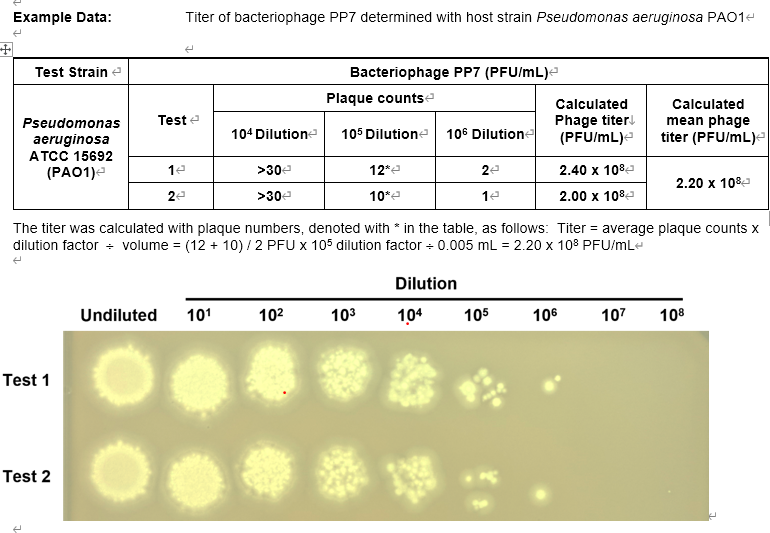
The phage spotting assay (PSA) for phage titration may be used to determine the concentration of a phage product measured as plaque-forming units per mL (PFU/mL). The assay may also be used to compare the susceptibility of different bacterial test strains to a phage product. The susceptibility is measured as the efficiency of plating, which is the titer of the bacteriophage measured with the test bacterial strain (PFU/mL) relative to the titer measured with a reference susceptible host strain.
ORGANISM
Bacteria
INCUBATION CONDITIONS
Aerobic
ASSAY INFORMATION
ASSAY TYPE
Functional
TESTING INFORMATION
PROCEDURE SUMMARY
The testing bacteriophage suspension is 10-fold serially diluted with phage dilution buffer (such as SM buffer) for a total of 9 concentrations (typical range is undiluted to 108 dilution). A 0.1 mL aliquot of overnight culture of test bacterial strain is combined with 3 mL molten top agar (such as 0.75% agar in LB) and spread evenly onto a bottom agar plate such as LB containing 1.5% agar. After solidification, 5 µL of each phage dilution is pipetted onto the surface of the top agar, then left to dry. Duplicate spots are generated from one dilution series. The plate is incubated at 37°C for 18 - 24 h then plaques are counted and PFU/mL values are calculated. Plaques are counted on the spots with 1 to 50 distinguishable plaques to calculate PFU/mL values.
CRITERIA FOR SIGNIFICANCE
The phage spotting assay (PSA) for phage titration is used to determine the concentration of a phage product measured as plaque-forming units per mL (PFU/mL).
TURNAROUND TIME
STANDARD
20 Days
CLINICAL RELEVANCE
THERAPEUTIC AREA
Infectious Disease
ADDITIONAL INFORMATION
BRAND
PDS
TESTING LOCATION
Taiwan - Taipei
ITEM DOES NOT EXIST
© Copyright 2026, Pharmacology Discovery Services – Privacy Policy | Cookie Notice | Cookie Preferences